


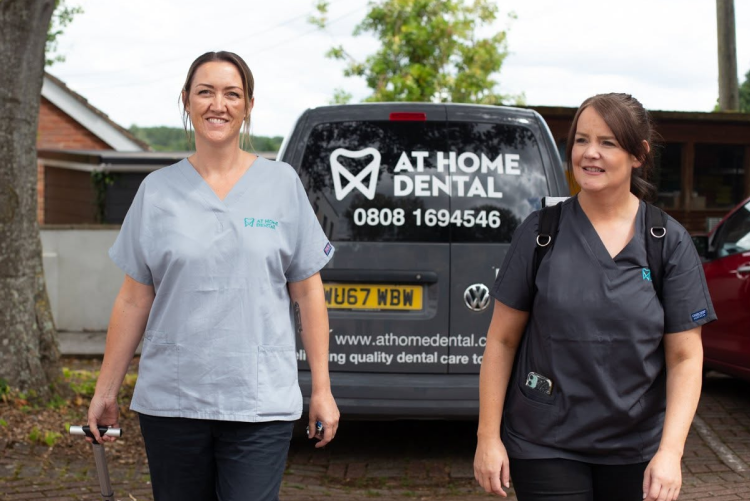
At Home Dental is a domiciliary dental service, bringing care directly to residents in care homes. Verity Shuker, At Home Dental’s Clinical Services Advisor, spoke with Irene, Kiroku's Marketing Manager, and Nuha, Kiroku Clinical Team, about how the service moved from individual clinicians using their own personal templates to a standardised, compliant approach to notes and correspondence, and how that's continued to evolve as new needs come up.
About At Home Dental
At Home Dental provides care to residents across 2,800 care homes across Devon, Hampshire, Bedfordshire, Oxford, Dorset and London & the Home Counties. Because the service is domiciliary, it works differently to a typical practice: the clinical team is responsible for its own correspondence, rather than that sitting with reception or admin staff in a fixed location.
Many of the residents At Home Dental sees don't have mental capacity, which means clear, timely communication with next of kin and power of attorney isn't a nice-to-have; it's central to how the service operates.
Personal templates, inconsistent standards
Before Kiroku, clinicians were completing their notes, but using their own personal templates. "Everybody was uploading their own personal templates," Verity said. That made it difficult to be confident every exam was capturing what it needed to, or that notes were consistently CQC compliant.
The gap wasn't just administrative. When correspondence didn't go out, families were left without basic information, and the clinical team lost a written record of what had been agreed with a patient or their next of kin. Verity described the pattern plainly: without a letter, there was no way of knowing whether a next of kin had actually been told what treatment had taken place, or what to expect next.
In at least one case, that gap had a direct clinical consequence. Patients weren’t explicitly told in writing to stop taking their anticoagulation treatment ahead of extractions. On a couple of occasions, patients took their anticoagulant as normal on the morning of an extraction, meaning the appointment couldn't go ahead.
Referrals followed a similar pattern before they were standardised: clinicians were completing referrals in one system without consistently logging them or notifying next of kin, which meant families and the wider team were often left asking whether a referral had actually happened.
Letters that go out, every time
Working with Nuha, Verity used Kiroku to build letter templates that pull together the relevant information from an appointment and put it into plain terms for next of kin and power of attorney. "This is the beauty of Kiroku," Verity said, "the fact that I've been able to work with Nuha to generate letters that clinicians have been able to send out containing all of the relevant information."
Nuha pointed to the time saved as much as the consistency: "The fact that it's so easy for them to click through everything and to then drag all that information into a doc, it has cut down their time without them probably even realising."
A pilot, then ongoing iteration
At Home Dental started with a pilot team before rolling the templates out more widely, and kept adjusting based on feedback. "We are constantly amending those clinical notes and letters," Verity said, "to make them CQC compliant and to suit the needs of the next of kins." Sections can be removed with a click if they do not apply to a particular patient, which Verity said clinicians have found straightforward.
That doesn't mean every clinician found the change easy. "You can't please everybody," Verity said. "With the pilot team, we got a lot of feedback, and we amended where appropriate."
Nuha was candid about the wider pattern: "Getting started with Kiroku is hard, especially on a widespread company basis. There will always be people that are hesitant, not really into it, really finding it hard to adapt." Verity added that ongoing support has been offered to the small number of clinicians who've found it more difficult, and that many of the team had already used Kiroku in other practices before joining At Home Dental.
Built around what actually comes up
Several of the templates At Home Dental now uses came directly out of specific situations, rather than being planned from the outset. The anticoagulant guidance above is one example, now built directly into the relevant letters so it's flagged every time rather than relying on a clinician to remember it case by case.
A referral template came out of the same issue: it now sets out clearly what a patient is being referred for, where they've been referred to, and the expected wait time, so referrals are logged consistently and communicated to next of kin rather than sitting in one system unnoticed. The team also built a prescription template that records the diagnosis and reason for prescribing, not just the drug and dose, which Verity said will make future antibiotic prescribing audits considerably easier to carry out.
"A lot of it has been on the go," Nuha said. "This problem has happened; we need to solve it and prevent it from happening in the future."
The impact beyond the appointment
Nuha noted that the benefit extends to families as well as clinicians, particularly given how many of At Home Dental's patients don't have capacity: "If the patient's next of kin is not there, they need to know what's going on. That level of communication, more people are gonna be like, well yes, I know what's going on with my granddad."
For Verity, the wider effect has been on admin time across the team, not just for clinicians completing notes, but for reception, who are no longer fielding the volume of queries they once were.
Families now have a clear written record of what treatment took place, in addition to the follow-up phone calls the team already made. "Reception is reading through those letters and saying, ' This was in your letter. This has been communicated to you'," Verity said.
Would she recommend it?
Asked what she'd tell another organisation weighing up whether to adopt software like Kiroku, Verity didn't hesitate: "It's been hugely beneficial for us as an organisation. The letters, they're just fantastic. They explain everything perfectly."
Nuha's view was that the change takes time, but pays off: "It's been over a year now that we've been implementing Kiroku, and only now are we seeing fewer and fewer problems and adaptations that we need to make. It does take time, but it genuinely is worth it."
If you're interested in introducing Kiroku for your team, please get in touch with us to discuss your needs.


