


Change Please is best known for its coffee, training and employing people who've experienced homelessness, and building a route back into stable work. Its Smile for Change bus takes that same mission into dentistry, bringing free dental care directly to communities who might otherwise struggle to access it.
Hannah, Kiroku's co-founder, and Irene, our Marketing Manager, spent time with the team to understand what a day on the bus actually looks like, and how Kiroku fits into it. This case study looks at how the team uses Kiroku day-to-day, from templates to compliance reporting, and the impact it’s had on clinicians as well as patients across London.
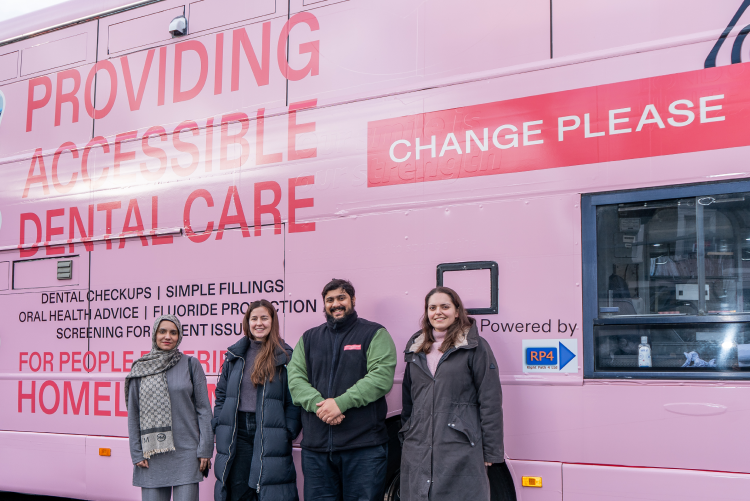
About Smile for Change
“Smile for Change is ultimately about breaking down barriers”, notes Mohamed, their Head of Clinical and Strategic Operations. The individuals they serve are homeless, which frequently intersects with alcohol and substance use. Consequently, they operate as a trauma-first practice; many patients have zero trust in the system and haven't seen a dentist in five, ten, or sometimes even more years.
Because their patients present with such complex needs, active engagement is critical. Patient feedback consistently shows how much they appreciate being actively listened to.
According to Mohamed, “That is exactly why Kiroku works for us. Having the software working in the background gives my team the luxury of time. We do not rush our treatments, and we do not rush our patients. It frees us from the screen, allowing us to maintain a proper conversation. As a direct result, our positive patient feedback has exploded, simply because patients genuinely feel heard.”
A different kind of practice
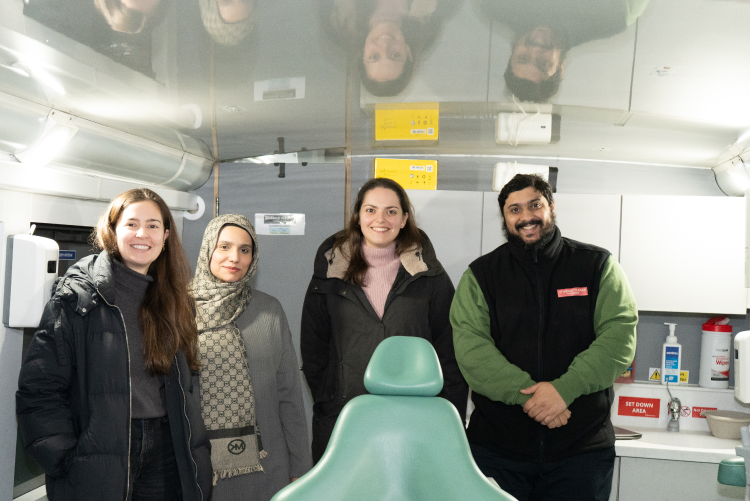
Most dental teams work from a fixed location, with the odd surgery variation between rooms but a fairly consistent setting in terms of patient demographics. The Change Please team doesn't have that. Every session means a different location, a different set of patients with complex needs, and a working day that's tightly bound by the practicalities of running a clinic on wheels.
Appointments are often longer than those typically seen in general dental practice, with clinicians needing time to understand the individual patient, build trust, consider wider circumstances and provide appropriate treatment.
Ibrahim, Dental Hygienist and Therapist on the bus, put it plainly: "On the bus, time is very critical. We're seeing sometimes more than five or six patients within a very short period of a day. Our day is like three, four hours on the bus."
Allan, Clinical Coordinator on the bus, is responsible for setting up and packing away at each session, since equipment can't be left running the way it might at a permanent surgery. He's also currently preparing for his ORE, working towards becoming a UK-registered dentist.
Templates that flex to the day
The team was introduced to Kiroku internally in early 2026. Since then, each clinician has built their own template.
"All the features that Kiroku has are honestly amazing, especially the AI ones that help you modify your notes, and the templates you can adjust beforehand," Ibrahim said. "I have my own template now. It's really something I dare to say is very hard to live without now."
That flexibility matters more on a bus than most places, because the range of treatment on any given day can shift quickly between an oral hygiene instruction, an examination, a clean or a filling. Ibrahim described Kiroku as covering "all of the aspects of the dental work from anywhere you want to reach it."
Some clinicians on the team also use Kiroku's Freestyle mode, which listens and writes up the notes afterwards rather than working through a structured template live. Others prefer having the workflow visible in front of them, so they can tick things off as they go, including anything they'd rather note down than say out loud in front of a patient.
Time back, and fewer notes taken home
For a service built around tight windows between patients, the time saved on notes has a knock-on effect that goes beyond admin.
"I'm now more confident and not as worried about the time of the appointment," Ibrahim said. "I have this peace of mind that my notes can be done very fast, and very accurately. I'm more focused on listening to the patient, on hearing them, on having a good conversation."
Allan noticed the same pattern from the other side, watching colleagues who hadn't adopted Kiroku yet. "I've seen some clinicians not using it, and those are the ones missing out on lunchtime, missing out on coffee time. This is part of the wellbeing of a clinician."
He also pointed to the effect on senior colleagues who were less familiar with the technology at first: "They always trust what they've done for the last thirty, forty years. But now, at the end of the day, they see the notes and can compare, so they know they're even better."
Asked to sum up the impact in one sentence, Allan didn't talk about notes at all: "It brings the work-life balance closer to an ideal. I've seen people not having lunch, or staying late, or bringing work home. It just helps with that."
More time looking at the patient, not the screen
Allan hadn't worked in UK dentistry before working on the Change Please bus and using Kiroku, which gave him an unusual vantage point on the difference it makes.
"I can compare with the ones who don't use it, because they're constantly looking at the screen and typing instead of facing the patient," he said. "There's so much non-verbal language you can pick up on, and just looking at the screen doesn't make sense to me. It's not personable anymore."
Ibrahim described a similar shift in how he sees his own role now. As he put it, the notes are Kiroku's job: his is to listen to the patient and give the best treatment possible.
Before, being on time and giving good treatment were both constantly on his mind. Now that the notes take care of themselves, he's able to give his full attention to the patient in front of him, listening more closely and having a proper conversation rather than working through an appointment at pace.
Patients notice the difference too, he added, often leaving feeling they'd had a proper appointment rather than a rushed one.
Mohamed echoes this, adding “Ultimately, while Kiroku is predominantly a tool used by clinicians, its greatest impact is actually felt by the patients we serve.”
Built for the specifics of the bus
Change Please's service comes with its own reporting needs, including anonymised end-of-day summaries that may be shared with local authorities. Ibrahim uses Kiroku's AI Editor to help produce these, asking for a short, anonymised summary of a case once his notes for the day are complete.
Mohamed agrees that Kiroku also supports their wider clinical governance, and is “invaluable” for care coordination from an operational perspective. They frequently share clinical reports with wider healthcare networks and key caseworkers, due to the nature of the demographic they serve.
“The software gives me absolute confidence that my team's notes are fully compliant,” he notes. “It also makes sharing this information much easier, knowing that patient consent has been properly captured and integrated into the workflow.”
The team also spoke about how it’s possible to add custom fields for anything that's better recorded discreetly than discussed out loud in front of a patient, such as flags around trauma-informed care. Free text and structured tick boxes can sit alongside each other, so clinicians can choose what works for a given patient or moment.
Getting started was easy
While the Kiroku team provided a brief training session to Change Please clinicians, the intuitive interface enabled clinicians to get started quickly.
Ibrahim also pointed to Kiroku's shared templates as an unexpected benefit: "The website suggests templates that other clinicians are willing to share, including some well-known names in the industry. Without Kiroku, I'd never have known about this, or it would have taken me much longer to find it."
Allan connected this back to Kiroku's own clinical roots: "I believe it's coming from a clinician, so it knows exactly what a clinician wants and delivers it."
In one sentence, Ibrahim summed it up as "definitely life-changing, in regard to saving time, being compliant, and for the well-being of the patient and the clinician."


